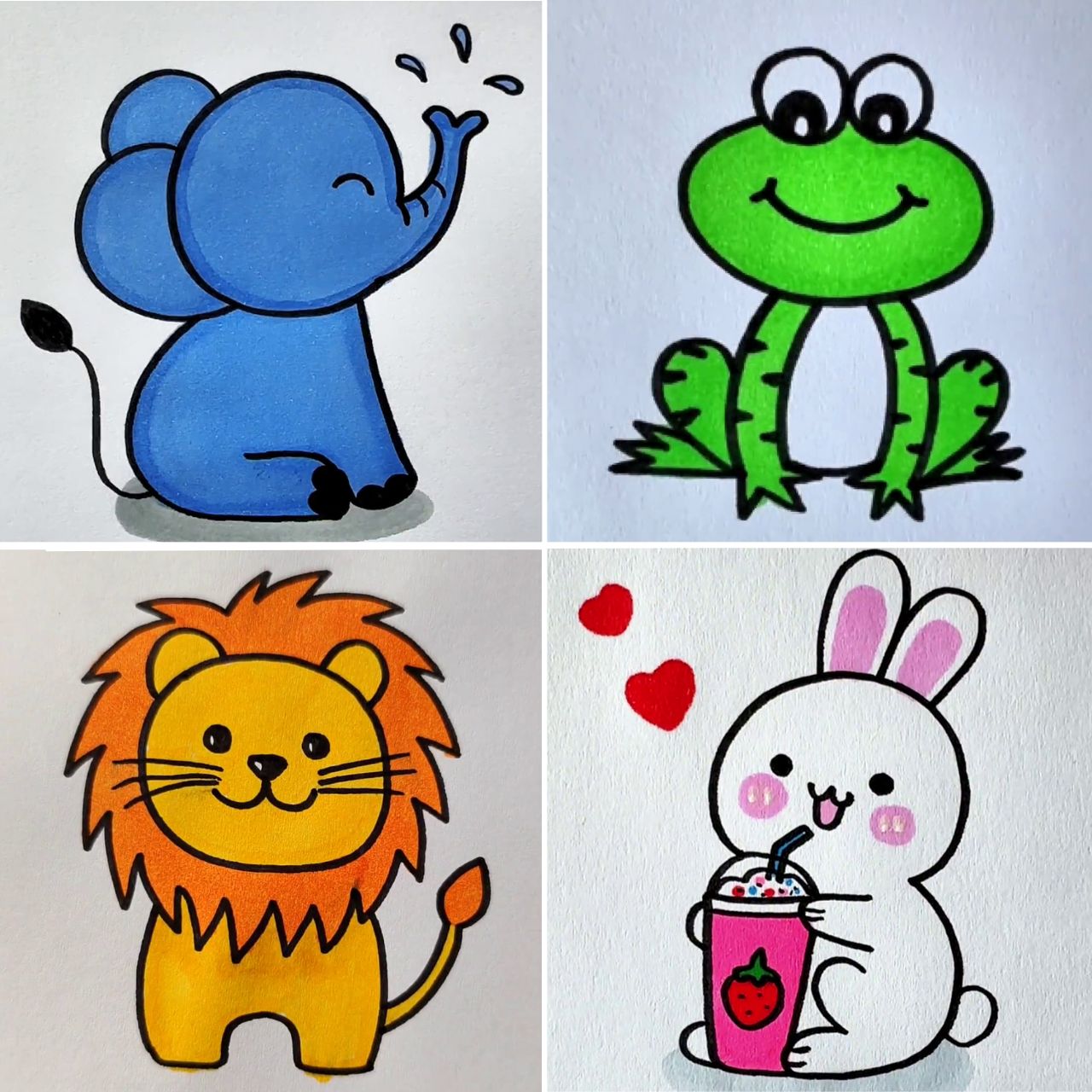
Simple Animal Drawing Ideas: Easy Step-by-Step Guides For Cute Creatures
Have you ever stared at a blank page, pencil in hand, wishing you could effortlessly sketch a adorable cat or a cheerful dog but feeling completely stuck on where to even begin? You’re not alone. The desire to draw charming, simple animals is one of the most common entry points into the world of art, yet the fear of creating something "bad" often holds us back. What if you could bypass that frustration and discover a collection of drawing ideas simple animals that anyone, regardless of skill level, can master with a few basic techniques? This guide is your key to unlocking that potential, transforming daunting blank pages into delightful galleries of your own making. We’ll move beyond basic stick figures and into the realm of recognizable, cute creatures built from foundational shapes, providing you with actionable steps and the confidence to keep practicing.
The beauty of starting with simple animal drawings lies in their power to build fundamental artistic skills without overwhelming the beginner. These exercises are not just for children; they are strategic training grounds for understanding form, proportion, and line. By breaking down complex creatures into manageable geometric components, you train your eye to see the underlying structure of all subjects. This method, used by professional artists for centuries, creates a solid foundation for any future drawing endeavor. Furthermore, the immediate gratification of completing a recognizable animal provides a crucial psychological boost, fueling your motivation to tackle more challenging subjects. In this article, we will explore a curated selection of the easiest animals to draw, provide detailed, foolproof step-by-step instructions, and equip you with the mindset and techniques to turn these simple sketches into personalized works of art.
Why Simple Animal Drawings Are Your Perfect Starting Point
Before we dive into the "how," it's essential to understand the "why." Embracing easy animal drawing ideas is a strategic choice that accelerates your artistic development. It’s the equivalent of learning to walk before you run; skipping this foundational stage often leads to frustration and abandonment of the hobby altogether. Simple animal drawings serve as a bridge between abstract shapes and realistic representation, allowing you to focus on one concept at a time, such as getting the body proportion right before worrying about intricate fur texture.
One of the primary benefits is the reduction of creative intimidation. A full, detailed portrait of a lion can seem impossible. A lion composed of a few circles and triangles? Suddenly achievable. This approach demystifies the drawing process. According to studies on motor skill learning, breaking a complex task into smaller, sequential steps significantly improves retention and success rates. Each completed simple animal becomes a building block, reinforcing your understanding of spatial relationships and boosting your fine motor control. You learn that art is a series of decisions—where to place a circle, how long to make a line—rather than a mysterious, innate talent.
Moreover, these exercises train your observational skills in a low-pressure environment. When drawing a simple bird, you’re not just copying an image; you’re analyzing it. You notice that the body is an oval, the head a smaller circle, the beak a triangle. You begin to see the world through an artist’s lens, a skill that translates to every other subject you’ll ever wish to draw. This shift from "I can’t draw that" to "I can break that down" is the single most important mindset change for any aspiring artist. It turns a fixed mindset ("I’m not artistic") into a growth mindset ("I am learning to see and represent").
Getting Started: Tools, Mindset, and Your First Lines
You don’t need a sophisticated studio to begin. The best tool for simple animal sketch practice is something you likely already have: a standard #2 HB pencil and a smooth piece of printer paper or a basic sketchbook. The HB pencil offers a good balance of darkness and ease of erasing, which is crucial for the light sketching phase. As you progress, you might enjoy a kneaded eraser for gentle lifting of graphite and a fine-line pen for finalizing your drawing, but these are not requirements for starting.
Your mindset is your most important tool. Adopt the mantra: "Progress, not perfection." Your first attempts will be wobbly, and that’s not only okay—it’s necessary. The goal of your first 50 sketches is not to create masterpieces but to train your hand-brain connection. Embrace the "ugly" phase. Use light, gentle strokes. Think of your initial lines as a conversation with the paper, not a final statement. A common beginner mistake is pressing too hard, creating dark grooves that are impossible to erase and make the page feel "ruined." Practice drawing circles and ovals of various sizes with a relaxed grip. This simple warm-up builds muscle memory and confidence.
Begin every drawing with a guideline structure. This is the non-negotiable secret to good proportions. Instead of drawing the final outline immediately, you construct the animal’s skeleton with basic shapes. A circle for the head, an oval for the chest and hindquarters, lines for the limbs. These guidelines are your temporary scaffolding. They allow you to adjust size and placement before committing. Once the structure feels balanced, you gently refine it into the animal’s actual form, and finally, erase the leftover guideline marks. This process eliminates the guesswork and dramatically improves accuracy.
5 Foolproof Simple Animal Drawing Ideas, Step-by-Step
Let’s move to the practical heart of this guide. Each of these animals is chosen for its reliance on basic shapes and minimal complex details. Follow these steps precisely, and you will be amazed at the results.
How to Draw a Simple Cat in 5 Easy Steps
Cats are a fantastic starting point due to their flexible, curved forms. We’ll use circles and flowing lines.
- Head & Body: Draw a medium-sized circle for the head. Below and slightly to the side, draw a larger oval for the body. Position them so they slightly overlap.
- Connect & Add Ears: Draw a gentle curved line connecting the head and body circles to form the neck and back. On top of the head circle, add two triangular ears. The inner ear can have a smaller triangle for detail.
- Face Guidelines: Lightly draw a vertical line down the center of the head circle and a horizontal line across the eyes. This cross helps place features symmetrically. On the horizontal line, draw two large, almond-shaped eyes. Below them, a small triangle for the nose, and a curved "W" shape for the mouth.
- Limbs & Tail: From the body oval, sketch four short, curved lines for the legs—two in front, two behind. Add simple oval paws. From the back of the body, draw a long, curving, tapered line for the tail. Think of it as a question mark shape.
- Finalize & Erase: Go over your final lines, making them clean and confident. Erase all the construction circles and guidelines. Add a few whisker lines from the nose area and a simple curved belly line.
How to Draw a Simple Dog (Puppy) in 5 Easy Steps
Dogs have a blockier, more rectangular shape than cats, making them a great contrast.
- Head & Snout: Start with a circle for the head. Attach a smaller, rounded rectangle or oval directly below it for the snout. This creates the classic puppy profile.
- Body & Legs: Draw a larger oval behind the head for the chest and body. From this body oval, sketch four short, sturdy lines for the legs. For a sitting puppy, the front legs will be straight down, and the back legs will be bent at the "knee" (hock).
- Ears & Face: Add floppy ears on the sides of the head circle—simple folded ovals work well. For the face, on the head circle, draw two circles for eyes. On the snout rectangle, add a dark nose at the tip and a smiling mouth line.
- Tail: Draw a short, curved, wagging tail on the back of the body oval. Keep it simple and fluffy-looking with a few curved lines.
- Refine: Connect all parts smoothly. Erase your guidelines. Add a collar with a simple rectangular tag if you like. The key to a cute dog is a large head relative to the body and a friendly expression.
How to Draw a Simple Bird in 4 Easy Steps
Birds teach you about streamlined shapes and adding key identifying features.
- Body & Head: Draw a small oval for the body. Attach a smaller circle to one end for the head. The connection should be seamless.
- Beak & Eye: On the head circle, draw a small triangle for the beak, pointing away from the body. Add a single dot or small circle for the eye near the beak.
- Wing & Tail: On the body oval, draw a large, curved teardrop shape starting from the top/back of the body. This is the folded wing. From the rear of the body, draw two or three long, straight lines for the tail feathers.
- Legs & Finalize: Add two very simple lines for legs coming from the bottom of the body, ending in tiny "V" shapes for feet. Clean up your lines. You can turn this into a robin by adding a red oval on the chest or a sparrow with streaks on the wing.
How to Draw a Simple Fish in 4 Easy Steps
Fish are perfect for practicing graceful curves and symmetry.
- Body Shape: Draw a long, pointed oval or a shape that looks like a leaf or a spindle. This is the entire body.
- Tail Fin: At the wider end of your oval, draw a large, triangular tail fin. It can be forked (like a crescent moon) or simply triangular.
- Dorsal & Side Fins: On the top of the body, draw a small triangular dorsal fin. On the side, near the middle, draw a smaller, more rounded pectoral fin. These are simple triangles or ovals.
- Eye & Details: Draw a single large circle for the eye near the front of the body. Add a curved line from the eye to the tail to show the side gill. You can add a few curved lines on the tail fin for a sense of movement. Erase any overlapping lines inside the body.
How to Draw a Simple Rabbit in 5 Easy Steps
Rabbits are all about roundness and long ears, making them incredibly expressive.
- Body & Head: Draw a large oval for the body. On top and slightly forward, draw a smaller circle for the head. They should almost touch.
- Long Ears: From the top of the head circle, draw two long, curved lines that taper at the ends. These are the iconic rabbit ears. They can stand straight up, flop slightly, or be one up and one down for character.
- Face & Paws: On the head, draw a small circle for the nose, and a curved line on each side for the cheek. Add a dot for an eye. From the front of the body oval, draw two short lines for the front paws, ending in simple ovals.
- Hind Leg & Tail: The back leg is a large, rounded shape—almost like a half-circle attached to the body. Draw a small, round puffball for the tail on the rear of the body.
- Polish: Connect everything smoothly. The back should have a gentle curve from the head down to the tail. Erase guidelines. A few whisker lines from the nose complete the cuteness.
Overcoming Common Beginner Mistakes in Simple Animal Sketches
Even with the best instructions, a few pitfalls can trip up new artists. Recognizing them is the first step to avoiding them. The most common error is ignoring the guidelines. Rushing to draw the final outline before establishing the basic shapes leads to animals that are lopsided, disproportionate, or simply "off." Always, always build with circles and ovals first. Treat them as your temporary, erasable friends.
Another frequent issue is uneven weight distribution. In your mind, the animal is floating in space. On paper, it needs to feel grounded. When drawing an animal standing, ensure its weight is centered over its feet. For a sitting animal, the body should be positioned directly over the folded hind legs. A quick trick: draw a simple line from the animal’s center of gravity straight down to the ground between its feet. This imaginary plumb line helps with balance.
Over-detailing too soon is also a problem. You might be tempted to draw every single whisker, stripe, or furrow on your first attempt. Resist! The initial goal is correct form and proportion. Details are the "icing on the cake" added in a final, separate step. If your cat’s body shape is wrong, adding perfect fur will only highlight the mistake. Work from general to specific: shapes > form > details > texture.
Finally, comparing your Chapter 1 to someone else’s Chapter 20. Your goal is your own progress. Follow the steps, complete the drawing, and then, on a separate piece of paper or in a new layer if you’re digital, try it again from memory. This repetition is where true learning happens. Each iteration will be slightly better as your brain and hands internalize the process.
From Simple Sketch to Charming Art: Adding Your Own Flair
Once you’ve mastered the basic structure of an animal, a world of creative expression opens up. The transition from a simple animal sketch to a piece of art is about adding personality and style through minimal, intentional choices.
Line Weight Variation: Instead of using one uniform line thickness, vary your pressure. Use a slightly darker, thicker line for the outer silhouette and the main features (like the eyes or nose). Use a lighter, thinner line for inner details like whiskers, fur tufts, or subtle folds in the ear. This creates depth and focus, guiding the viewer’s eye.
Simple Shading for Form: You don’t need complex rendering. Identify a consistent light source (e.g., light coming from the top-left). Shade the areas that would be in shadow: the underside of the body, the inner parts of the ears, the area under the tail. Use soft, circular motions with your pencil and blend gently with a fingertip or tissue. Just two values—light and shadow—can make your flat drawing suddenly look three-dimensional.
Expressive Faces: The eyes and mouth are the soul of your animal. Experiment with different shapes. A simple change from a dot to a larger circle with a small white dot for a highlight can change a sleepy animal to an alert one. A curved mouth line can be a smile, a grimace, or a neutral expression. Play with eyebrow shapes (even if implied by the forehead line) to convey surprise, curiosity, or contentment.
Pattern Play: Many simple animals are a canvas for fun patterns. Instead of solid color, try drawing a tiger with simple curved stripes, a ladybug with a dotted back, or a cow with irregular patches. This adds visual interest and is a great way to practice controlled, repetitive mark-making. Keep the patterns simple and contained to specific body parts to avoid visual clutter.
Conclusion: Your Artistic Journey Starts with a Single Circle
The path to drawing proficiency is paved with countless circles, ovals, and lines. What we’ve explored here—drawing ideas simple animals—is more than just a collection of tricks; it’s a foundational philosophy. It teaches you to deconstruct the complex world into understandable parts, to build confidence with each completed sketch, and to see the playful potential in every blank page. The cat you drew with a circle for a head, the dog with its blocky snout, the bird with its teardrop wing—each one is a testament to your ability to learn and create.
Remember, every master artist started exactly where you are now. They too once struggled to draw a simple oval. The difference is they practiced the fundamentals relentlessly. Your challenge is this: choose one animal from this guide right now. Grab a pencil and a piece of paper. Follow the steps without judgment. Do it again tomorrow. And the next day. Fill a sketchbook with these simple creatures. Watch as your lines grow steadier, your proportions more accurate, and your unique style begin to emerge from the foundation of simplicity. The world of art is vast and wonderful, but your journey into it begins with the humble, powerful act of drawing a single, simple shape. Now, go draw that circle. Your first adorable animal is waiting.